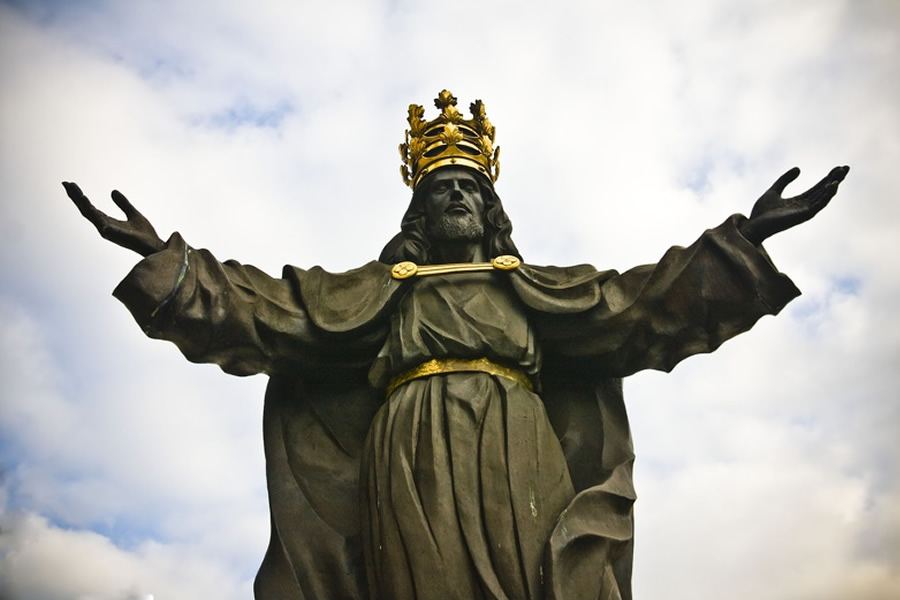
Feast of Christ the King - Jesus, I Trust in You
by Deacon Bob Evans | 11/20/2025 | Weekly ReflectionThis year, on the feast of Christ the King, we hear in the Gospel one of the most moving stories we will ever hear. In a moment of great suffering, Jesus replied to one who had turned to Him and said, "Amen, I say to you, today you will be with me in Paradise." [Luke 23:43]. This gives us all great hope, but there's more to the story.
In the accounts of the Passion of Christ, the words convey the stark reality that Jesus suffered and died for us at the hands of evil men. But, true to the mission of transmitting the Christian faith, the evangelists were not primarily teaching what happened, rather they were teaching faith and encouragement lessons using stories about what happened [cf: CCC #425].
In doing so, in this passage Luke made use of a common Middle Eastern literary form, known as a semukha. In a semukha, the writer/speaker placed in contrast two related ideas, statements or actions to draw attention to an underlying principle. The underlying principle always went unstated; it was the role of the reader/listener to discern the intended underlying principle.
In Middle Eastern storytelling, what is conveyed in dialogue is more 'telling" than what is conveyed in narrative. 2 So, we need to pay close attention to what Luke recounted as spoken words. Luke related the exchange in a manner that placed in contrast the words of the first criminal with those of the second criminal to convey an underlying principle of great importance to his faith community, and to us.
The first criminal was taunting Jesus, just as the soldiers and rulers were: "Are you not the Messiah? Save yourself and us!" Before Jesus could respond to him, the second criminal rebuked the first criminal and then said: "we have been condemned justly, for the sentence we received corresponds to our crimes, but this man has done nothing criminal." Then he asked: "Lord, remember me when you come into your kingdom."
The first criminal sought to compel Jesus to grant what he wanted; the second criminal asked for what he needed most. In following carefully what was said, we note that the second criminal began by expressing remorse over his own sins and failings. He then addressed Jesus as Lord, fully expecting that Jesus would remember him with mercy. The underlying principle: at its very core, a prayer of petition should begin with acknowledging our guilt and remorse and, as agonizing as our words may be, our petition must arise out of faith in God's mercy.3
This was a very important lesson for Luke's community, of primarily Gentiles, who came from a pagan experience of prayer that had nothing to do with remorse or faith but was all a matter of bargaining with the gods and expressions of entitlement. In our transactional times, we are very accustomed to bargaining with one another. Sadly, bargaining can seep into our prayers as well: "Lord, do this for me and I'll do that." As Luke taught, this not the right approach to prayers of petition and this point is elaborated on in the Catechism of the Catholic Church, art. 2629-2633.
1. Avraham Goldberg, The Semukha - a Compositional Form of the Rabbinic Homily, (Jerusalem: Magnus Press, 1985).
2. Robert Alter, The Art of Biblical Narrative, (New York: Basic Books, 1983).
3. Daniel P. Horan, The Last Words of Jesus, (Cincinnati: Franciscan Media, 2014).