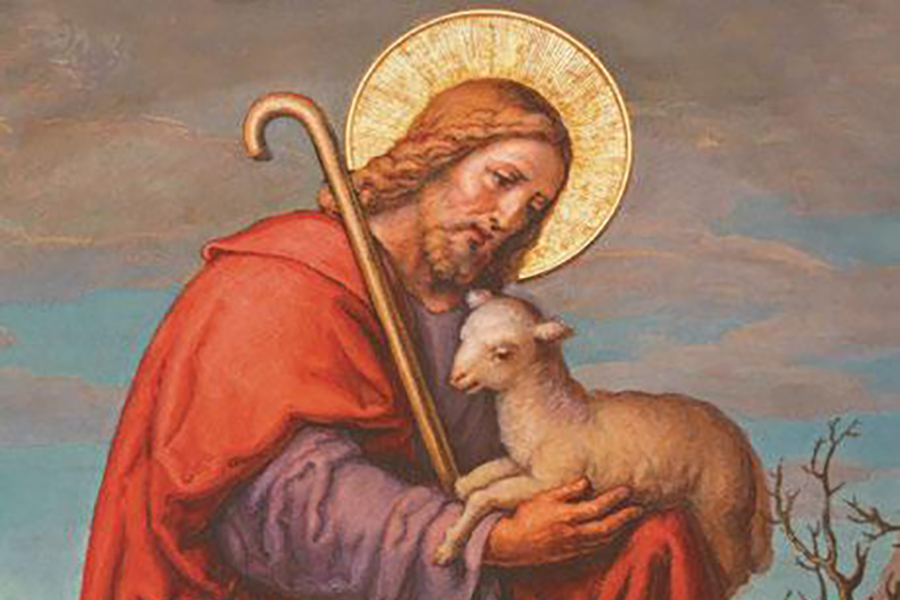
God's Laws are Centered in Love
by Dcn Bob Evans | 10/22/2026 | Weekly ReflectionThe theme of this week's readings is that God's laws are centered in love and must be interpreted in light of love.¹ Let's see how that plays out in our Readings. Our First Reading [Exodus 22:20-26] comes from what was known as the 'Covenant Code" in the Book of Exodus. These were regarded as ways, derived from the Ten Commandments, to express our love for others. And failure to observe these "laws" was considered inflicting injury on our neighbor which would incur the wrath of God.
The theme, "God's laws are centered in love" is continued in our Gospel reading [Mt 22:34-40] where Jesus made it clear to the Pharisees that God's ultimate "law" requires that we love our neighbor in order to love God "with allyour heart, with allyour soul, and with allyour mind" [Mt 22:37b].
What underlies this bond of God's law and love is the assurance of God's love for us; for which we are to regularly offer expressions of thanksgiving. And that is just what the psalm [Psalm 18] for this weekend is: a profound expression of thanksgiving by David, known as a "Todah Hymn." Our English word, Eucharist, comes from the Greek word, eucharistia, which means "thanksgiving," or in Hebrew: todah.
Several of the psalms were Todah Hymns, profound expressions of thanksgiving for the assurance of God's love. And what we now call the Eucharistic Prayer at Mass was, in the early Church, also called the Todah Hymn.2 The practice in the early Church was that the one who offered the thanksgiving celebration was the one who composed the hymn. So, for many years, each presider at Mass composed his own Todah Hymn. Some of those Todah Hymns were marvelous, others not so much; and in time the bishops took over composing the Todah Hymns to be used in their area of authority.
One of the most widely used Todah Hymns was composed by a bishop named Hippolytus in the year 215. This prayer was long known as the Apostolic Tradition. We still use that prayer at Mass to this day: it's the Second Eucharistic Prayer in the modern Sacramentary. In the year 390, St. Ambrose composed a Todah Hymn that came to be known as the Roman Canon. It is now the First Eucharistic Prayer. In 1968, two more Todah Hymns (or Eucharistic Prayers) were composed by Fr. Cipriano Vagaggini, at the request of Pope Paul VI. Today, the celebrant of each Mass chooses the Eucharistic Prayer most fitting to the circumstances of the community at that Mass.
The Eucharistic Prayer begins at the Sanctus (Holy, Holy, Holy) and ends with the elevation of the chalice and paten with the host. When we embrace the Eucharistic Prayer (or Todah Hymn) at Mass as our prayer, as the expression of our thanksgiving, then we come to see the Eucharist as something we do, not something we attend orjust show up for. It changes the whole character of why we are at Mass. That line from St John's 1st Letter really hits home: "We love God because He first loved us" [1 Jn 4:19].
When we place ourselves in the Todah Hymn, we move from the here and now into the timeless world of God alongside the angels, if only for the short time we are there. We give thanks for the assurance of God's love for us. We then "go forth to glorify the Lord with your life" in how we love others. For that's how we are to love God "with all your heart, with allyour soul, and with allyour mind." Indeed, with God's laws centered in love, there is much for us to give thanks for, in spite of the troubled world we leave outside the Church door.
BACK TO LIST