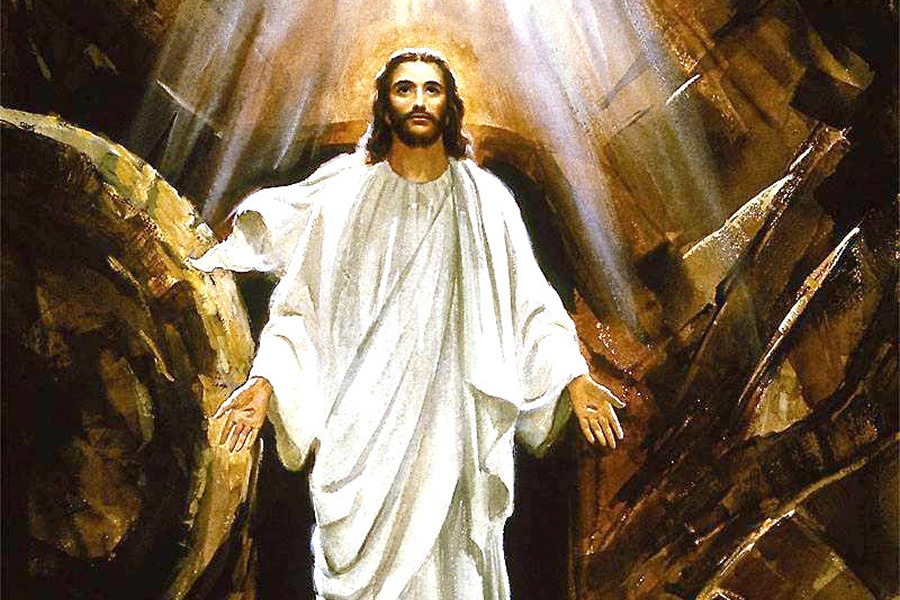
Grace Changes Everything
by Dcn Bob Evans | 04/23/2026 | Weekly ReflectionFor the last two weeks we've been hearing in the Gospel readings about how fearful and disbelieving Jesus' disciples were about Jesus having risen. They were despondent, some were even in hiding weeks after having seen the Risen Jesus. But, in our First Readings, Luke's been telling us about the zeal and boldness of Peter and John as they went about openly proclaiming the good news of Jesus Christ. What happened between the times described in the Gospels and the times described in Acts that accounts for this?
Pentecost happened! The Holy Spirit came upon those in the Upper Room with an outpouring of His grace, and they were transformed by grace into being believers and doers. No longer did they hide; no longer were they timid and afraid. They went out into the Temple area, the streets and homes, even working miracles. You see, grace changes everything. That's what's made the difference between what we hear in the Gospel readings and what we hear in the First Readings from Acts. Grace did that for Jesus' disciples; it can do it for us as well. Grace is what empowers us to do the will of God in our times and circumstances.
Grace dispels doubt and transforms good intentions into actions. The Catechism tells us that grace is "the free and undeserved help that God gives us to respond to his call" [CCC #1996]. But grace is not a "magic potion." It can have no effect in our life if we are not open, as the disciples were, to the Holy Spirit working in us. As Pope St. John Paul II wrote, "We can only receive grace if we are open to grace" [Veritatis Splendor, Aug. 1993].
In reflecting on how grace changed everything in the lives of Jesus' disciples, we're naturally led to the question, "Are there things we can do that will help us become more open to grace?" Certainly, there are. But there's one thing in particular that I'm very familiar with and would like to tell you about.
Following the Spanish Civil War of 1936-1939, there was a great spiritual malaise throughout Spain. A sense of despair had swept across Spain, and the churches were nearly empty. The few who still attended were mostly elderly women. So, in the summer of 1944, a small group of men gathered on the Spanish island of Mallorca, asking themselves the same question we hear in this Sunday's First Reading: "what are we to do, my brothers?" [Acts 2:37], to try to bring an openness to grace back to Spain. The group turned to reviving the medieval pilgrimages to Compostela, the Shrine of St James, the patron saint of Spain.
But first, they would prepare those who were to go on the pilgrimages through a set of 3-day short courses (called "Cursillos"). These Cursillos would focus on encountering the Holy Spirit, on better understanding the sacraments, and on dealing with the obstacles to God's grace. Well, reviving the pilgrimages was a good idea, but it was the Cursillos that were having the most profound effect in bringing an openness to grace.
The Cursillo Movement spread rapidly around the world and it arrived in Phoenix in 1959. So far, more than 26,000 men and women in the Phoenix area have experienced their once-in-a-lifetime Cursillo. Over the years, more than 300 from this parish have made their Cursillo. In fact, there's a women's Cursillo going on this weekend at Mt Claret.
If you are interested in knowing more about Cursillo, just ask our Cursillo Parish Reps: Mick and Melissa Kapanicas at 602-509-4306. For many, Cursillo has been life-changing. It continues to be one of the best ways of opening ourselves to the graces of the Holy Spirit. And grace can change everything if we will just let the Holy Spirit work in us.
Dcn Bob Evans
BACK TO LIST