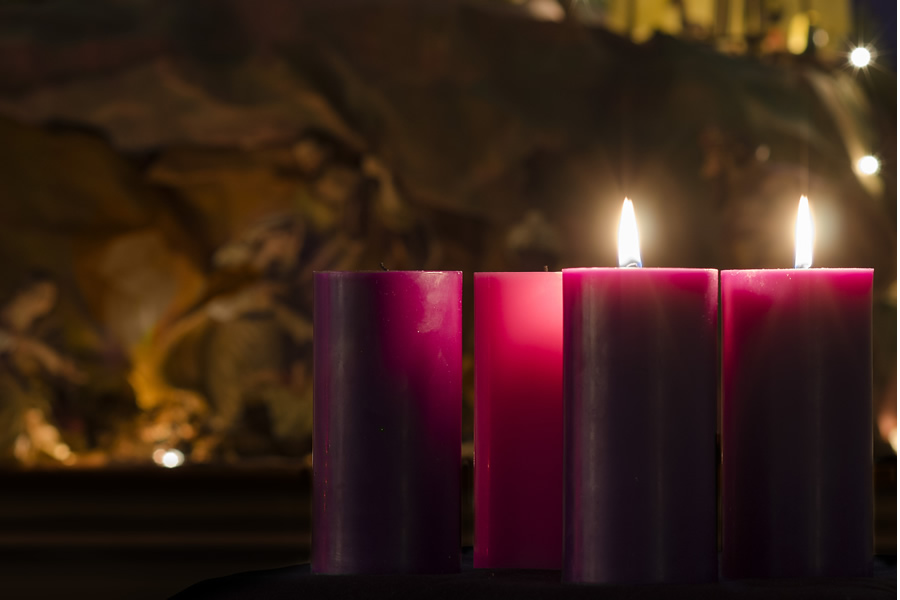
Second Sunday of Advent
by Fr. Thomas Kagumisa | 12/04/2025 | Weekly ReflectionIt is the second Sunday of Advent, a time for us to prepare for the coming of our Lord and Savior. As I mentioned last Sunday, the first two weeks of the Advent season focus on the second coming of Christ, often referred to as eschatology, for which we do not know the specific day or hour. This emphasizes the importance of preparing the way for the Lord.
Accordingly, today's first reading describes the Messiah, the Christ who is to come, including His characteristics and His actions. Speaking of the coming of the Messiah, the prophet Isaiah says, "He shall not judge by what His eyes see or decide by what His ears hear; but with righteousness, He shall judge the poor and decide with equity for the meek of the earth."While humanity tends to judge by what they see or hear, Jesus judges our consciences. He looks at our hearts rather than our appearances. This aspect is unique to the Messiah.
Also, in the Gospel, John the Baptist says of the Messiah, "I baptize you with water for repentance, but one who is more powerful than I is coming after me... He will clear his threshing floor and gather his wheat into the granary, but the chaff will be burned with unquenchable fire." So, by looking at our consciences, the Messiah knows who the "wheat" are-those who are righteous and sincere-and who the "chaff" are-the unworthy. Both Isaiah and John the Baptist proclaim the divinity of Christ, the only one able to judge our consciences and determine our eternal reward or condemnation. This prophetic message should inspire us to respond with greater urgency to the call to prepare the way for the Lord.
How do we prepare the way for the Lord? We do this by "filling in the valleys," as the prophet Isaiah (40:4) states, which is quoted by John the Baptist in today's gospel. Filling in the valleys means identifying what is lacking in our Christian lives and taking action. This involves avoiding sins of omission, such as willfully neglecting to attend church on Sundays, failing to be actively involved in our parish community, or failing to engage in "good works,"like December 7, 2025 feeding the hungry, clothing the naked, and visiting the sick. It may also include neglecting our daily prayers.
We also prepare the way for the Lord by pulling down the mountains of pride, envy, deceit, indecency, jealousy, evil desires, or ideas that lead someone to kill, commit adultery, lie, slander others, or do other immoral things. Jesus wants us to pull down these mountains and make inside our hearts, a path that is levelled and smooth. We have the opportunity to bring this about by participating in the Communal Celebration of the Sacrament of Reconciliation on Wednesday, December 17, 2025, at 6:00 PM.
The preaching of John the Baptist was particularly effective because his life exemplified his message more powerfully than his words. He wore clothing made of camel hair, a leather belt around his waist, and his diet consisted of locusts and wild honey. His life of sacrifice, detachment, honesty, and dedication attracted large crowds. Similarly, we can convince and convert people not just through our words, but by our actions and the way we treat them. Actions truly speak louder than words.
This truth is especially relevant within families. What parents do has a significant impact on their children, whether positive or negative. During the World Youth Day on January 1, 1996, St. Pope John Paul II noted that some children are forced to endure the trauma of their parents' quarrels and conflicts, often absorbing negative behaviors such as hostility, hatred, and aggressiveness. The actions of parents greatly influence their children and often convey more than spoken words. Let our behaviors foster strong relationships that serve as positive examples for the young ones in our lives.
May the God of power and mercy open our hearts in welcome. May He remove any barriers that prevent us from receiving Christ with joy, so that He may come and dwell within us, for He is our Immanuel.
In God's service and yours,
Fr. Thomas Kagumisa